Introduction
In the modern academic landscape, students and researchers face immense pressure to produce high-quality written work under tight deadlines. The process of researching, drafting, citing sources, and polishing an essay can be overwhelming, especially when juggling multiple assignments. Textero AI Essay Writer (available at https://textero.ai/) is a powerful AI-powered writing assistant designed specifically to address these challenges. Unlike generic text generators, Textero.ai is built with academic integrity and efficiency in mind. It leverages advanced language models to help you create original, plagiarism-free essays, research papers, and other academic documents from simple prompts, outlines, or uploaded sources.
This tutorial will guide you through every aspect of using Textero AI, from your first login to mastering its advanced features. Whether you are a high school student struggling with a term paper, a university undergraduate facing a research proposal, or a graduate student needing to expand a literature review, this guide will help you harness the full potential of the tool. By the end, you will understand how to generate content, properly cite sources, paraphrase existing text, and expand your ideas—all while maintaining academic standards.
Getting Started with Textero AI
Creating Your Account and Logging In
To begin, navigate to https://textero.ai/ in your web browser. You will be greeted by a clean, modern interface. Click on the prominent “Sign Up” or “Get Started” button. You can register using your email address and a password, or you may have the option to sign up using your Google or Microsoft account for faster access. Once you have confirmed your email (if required), log in to the dashboard.
Understanding the Dashboard
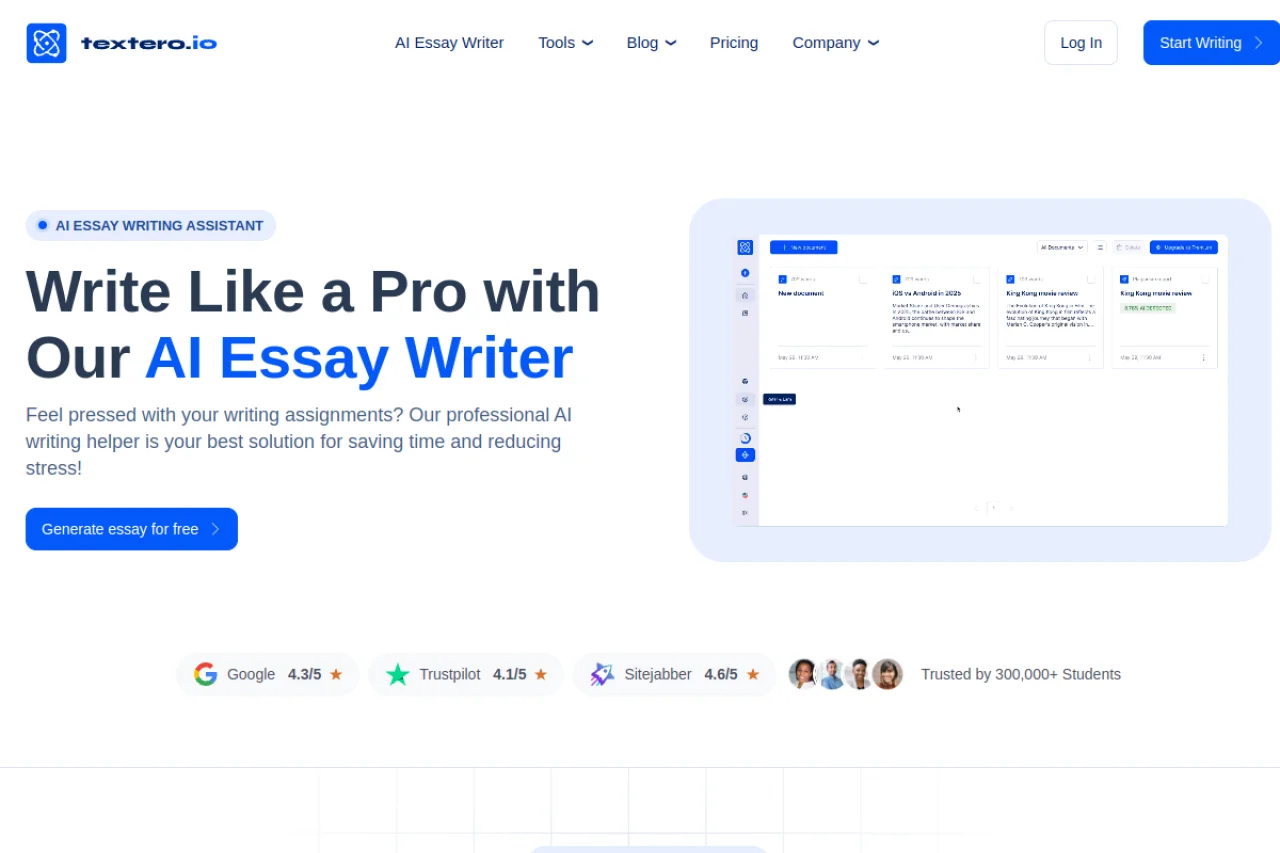
Upon logging in, you will see the main workspace. The dashboard is designed to be intuitive. Key elements include:
- New Project Button: Usually a large “+” or “Create New” button to start a fresh essay or document.
- Project Library: A list of your saved projects. You can return to edit or download them later.
- Quick Tools Menu: Icons or tabs for specific features like “Paraphrasing,” “Summarization,” or “Citation Generator.”
- Account Settings: Where you can manage your subscription, change your password, or view your usage statistics.
Selecting Your Plan
Textero.ai typically offers a free tier with limited credits (e.g., a certain number of words or generations per month) and paid subscription plans for unlimited or higher-volume usage. Review the pricing page to choose a plan that fits your needs. For this tutorial, we assume you have access to the basic features.
Key Features in Detail
1. Essay Generation from Prompts or Outlines
This is the core functionality. You can generate an entire essay by providing a simple prompt (a sentence or two describing your topic) or a structured outline. The AI understands academic context and produces coherent, well-organized text.
- Prompt-Based Generation: Ideal for brainstorming or getting a first draft. Example prompt: “Discuss the impact of social media on mental health among teenagers.”
- Outline-Based Generation: More control. You provide headings and sub-points, and the AI fleshes out each section. This is excellent for research papers where you already have a structure in mind.
2. Plagiarism-Free Content with Citations
Academic integrity is paramount. Textero.ai generates original text, but it also helps you cite your sources correctly. You can input URLs or upload PDFs, and the tool will extract key information and suggest in-text citations and a bibliography. The system supports multiple citation styles, including APA, MLA, Chicago, Harvard, and more.
3. Paraphrasing and Rewriting Tools
Sometimes you have a paragraph that is well-written but needs to be reworded to avoid plagiarism or to fit a different tone. The paraphrasing tool allows you to paste text and receive a rewritten version that retains the original meaning but uses different vocabulary and sentence structures. You can adjust the level of rewriting (e.g., more conservative vs. more creative).
4. Content Expansion and Summarization
These two features are opposites but equally useful:
- Content Expansion: If you have a short paragraph or a few bullet points, you can ask the AI to expand on them, adding details, examples, or explanations. This is perfect for developing thin sections of your paper.
- Summarization: When you have a long article, book chapter, or even your own draft, you can generate a concise summary. This helps with literature reviews or when you need to present key findings quickly.
How to Use Textero AI: A Step-by-Step Guide
Step 1: Starting a New Essay Project
Click on the “Create New” or “New Essay” button. You will be presented with a form. Here is what you need to fill out:
- Title: Give your essay a working title (you can change it later).
- Essay Type: Choose from options like “Argumentative,” “Persuasive,” “Descriptive,” “Narrative,” “Research Paper,” or “Expository.”
- Academic Level: Select “High School,” “Undergraduate,” “Graduate,” or “PhD.” This adjusts the complexity of vocabulary and depth of analysis.
- Number of Pages/Word Count: Set a target length. The AI will aim to generate content that meets this requirement.
- Citation Style: Choose APA, MLA, Chicago, etc. This will format all citations automatically.
Step 2: Providing Input – Prompt or Outline
You now have two main paths:
- Option A: Simple Prompt. In the text box, write a clear, detailed prompt. For example: “Explain the causes of World War I, focusing on the alliance system, nationalism, and the assassination of Archduke Franz Ferdinand. Include the perspectives of major powers.” The more specific you are, the better the output.
- Option B: Outline. If you prefer structure, switch to the “Outline” tab. Here you can add your own headings (e.g., Introduction, The Alliance System, Nationalism in Europe, The Assassination, Conclusion). Under each heading, you can add bullet points or short notes. The AI will write full paragraphs for each section.
Step 3: Adding Sources (Optional but Recommended)
To make your essay credible and properly cited, you can upload sources. Look for an “Add Source” or “Upload” button. You can:
- Paste a URL from a reputable website, journal article, or news source.
- Upload a PDF or Word document containing research material.
- Manually enter source details (author, title, year, publisher).
The AI will analyze these sources and integrate relevant information into your essay, complete with in-text citations and a reference list at the end.
Step 4: Generating the Content
Once you have configured everything, click the “Generate” or “Write Essay” button. The AI will process your request. Depending on the length and complexity, this may take 30 seconds to a few minutes. You will see the text appear section by section. You can stop the generation at any time if you are satisfied with what you have so far.
Step 5: Reviewing and Editing the Output
The generated text is a draft, not a final product. Read through it carefully:
- Check for accuracy: Does the AI correctly represent historical facts or scientific concepts? Correct any errors.
- Adjust the tone: The AI may sound too formal or too casual. Use the built-in paraphrasing tool to rephrase specific paragraphs.
- Verify citations: Click on any citation to see the source. Ensure the AI did not fabricate a source (a known risk with some AI tools). Textero.ai is better than most, but always double-check.
Step 6: Using the Paraphrasing Tool
If a sentence or paragraph does not sound right, highlight the text. Look for a “Paraphrase” button (often a small icon or option in a pop-up menu). Click it, and the AI will offer a rewritten version. You can choose to replace the original or keep it for comparison. You can also adjust the “creativity” slider: a lower setting keeps the meaning very close, while a higher setting changes the structure more dramatically.
Step 7: Expanding or Summarizing Sections
For underdeveloped parts:
- Select the text or place your cursor where you want more content.
- Click “Expand” to add more details, examples, or analysis.
- For long sections, use the “Summarize” feature to create a concise version. This is especially useful for abstracts or conclusions.
Step 8: Finalizing and Exporting
When you are satisfied with the content, you can export your essay. Look for an “Export” or “Download” button. Common formats include:
- DOCX (Microsoft Word): Best for further editing.
- PDF: Good for submission if no further changes are needed.
- Plain Text (TXT): For pasting into other platforms.
Before exporting, ensure the citation style is correct and the reference list is complete. You can also copy the text directly and paste it into your word processor.
Tips for Getting the Best Results
1. Write Detailed Prompts
The quality of output is directly proportional to the quality of your input. Avoid vague prompts like “Write about climate change.” Instead, try: “Write a 1000-word argumentative essay on the effectiveness of carbon taxes in reducing greenhouse gas emissions, citing at least three peer-reviewed studies from the last five years.” This gives the AI clear direction.
2. Use Outlines for Complex Topics
For research papers with multiple sections (e.g., Literature Review, Methodology, Results, Discussion), always use the outline feature. It prevents the AI from going off-topic and ensures logical flow. You can even provide sub-points under each heading to guide the content.
3. Always Verify Sources
While Textero.ai is designed to generate accurate citations, no AI is perfect. If you upload a source, the AI should use it correctly. However, if you rely on the AI’s internal knowledge, it might generate a plausible-sounding but fake citation (a phenomenon known as “hallucination”). Cross-check any source you are unsure about in your university library or Google Scholar.
4. Use Paraphrasing to Avoid Plagiarism
Even though the AI generates original text, if you paste a sentence from a source and ask the AI to paraphrase it, always run the result through a plagiarism checker (like Turnitin or Grammarly) as a safety measure. Also, remember that paraphrasing still requires citation—the AI will usually add one automatically.
5. Combine Expansion and Summarization
Don’t be afraid to use both tools on the same section. For example, you might first expand a thin paragraph to add depth, then summarize it to create a tighter argument. This iterative process helps refine your writing.
6. Adjust Academic Level and Tone
If you are writing for a high school class, select “High School” to avoid overly complex jargon. For a PhD dissertation, choose “Graduate” or “PhD” to ensure the language is sophisticated. You can also manually instruct the AI in the prompt, e.g., “Use formal academic language suitable for a peer-reviewed journal.”
7. Save Your Work Frequently
Textero.ai usually auto-saves your projects, but it is good practice to manually save after significant edits. Use the “Save” button or ensure you are connected to the internet to prevent data loss.
8. Use the Citation Generator Independently
You do not have to be inside an essay project to generate citations. Most versions of Textero.ai have a standalone citation tool. If you find a great source while browsing, paste the URL or DOI into the citation generator, select your style (APA, MLA, etc.), and copy the formatted citation directly into your reference list.
9. Start with a Free Trial
If you are new, use the free credits to test the tool on a short assignment (e.g., a 500-word essay). See how the AI handles your topic, and experiment with different prompts and outlines before committing to a paid plan.
10. Do Not Rely Solely on AI
Textero.ai is a powerful assistant, but it cannot replace your own critical thinking, unique insights, or personal voice. Use the generated text as a foundation or a source of inspiration. Add your own analysis, examples from your experience, and original arguments. The best essays combine AI efficiency with human creativity and rigor.
Conclusion
Textero AI Essay Writer is a versatile and robust tool that can significantly reduce the time and stress associated with academic writing. By understanding its key features—essay generation, citation support, paraphrasing, expansion, and summarization—you can streamline your workflow from initial research to final draft. Remember that the tool works best when you provide clear instructions, verify its outputs, and use it as a collaborative partner rather than a replacement for your own intellect. Whether you are drafting a simple book report or a complex dissertation, Textero.ai offers the support you need to produce polished, well-cited, and original academic work. Visit https://textero.ai/ today to start your first project and experience the future of academic writing assistance.

Textero AI Essay Writer
AI-powered tool for generating academic essays and research papers.